The libraryFree book
Vibe Modelling
Build digital twins with AI as your co-pilot: a guide for managers, analysts and operators who understand their operation completely and have no intention of learning to program. The machine writes the Python; you ask the questions.
Get the free copy
The eBook arrives within minutes. Occasional simulation notes too; unsubscribe whenever you like.
Prefer paper or Kindle? Both editions are on Amazon.
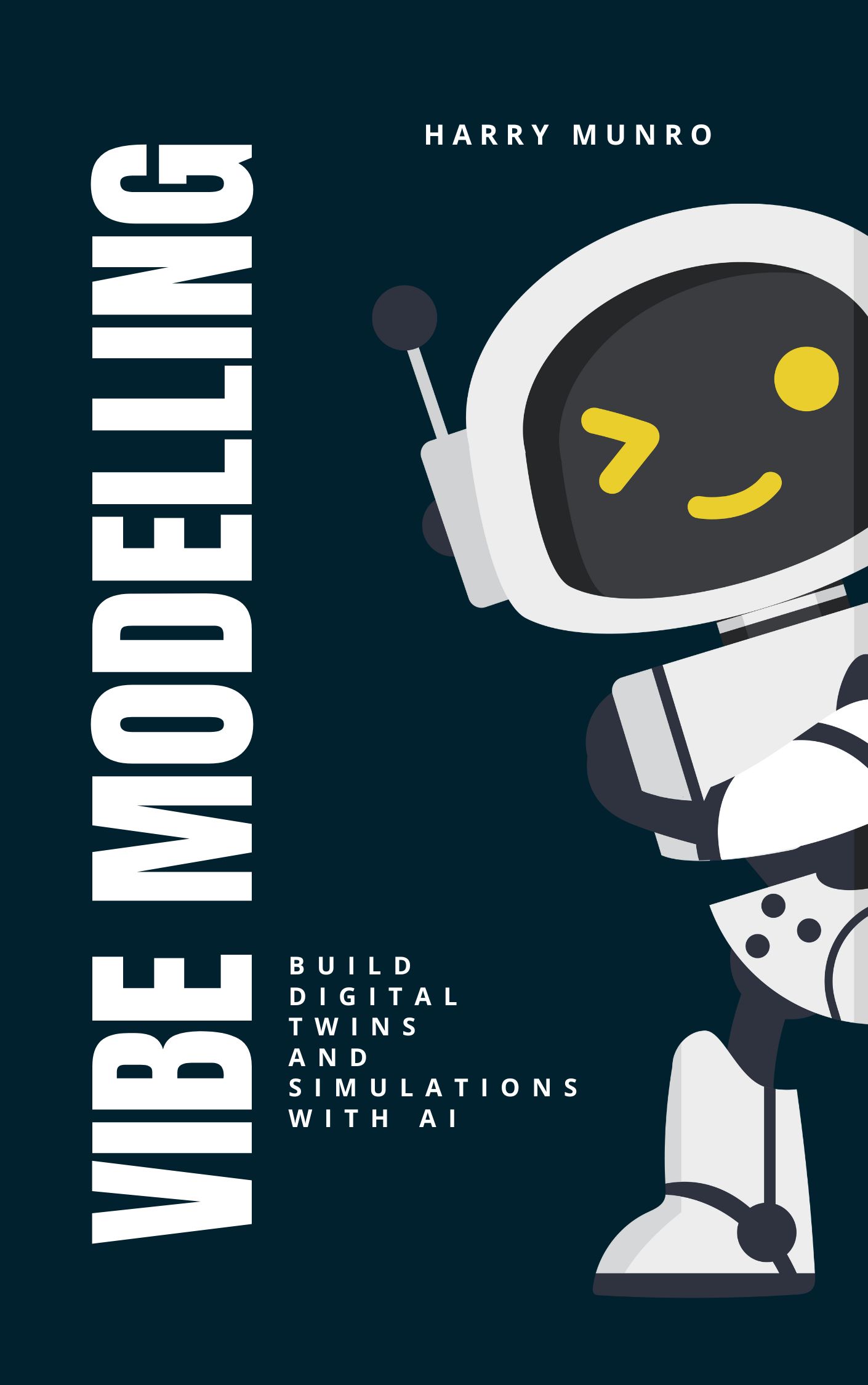
- Title
- Vibe Modelling: Build Digital Twins with AI
- Author
- Harry Munro, CEng MIMechE
- Method
- A six-step framework, from vague question to verified simulation
- Prerequisites
- Operational knowledge and curiosity; no programming
- Also available
- Paperback and Kindle, via Amazon
- Price
- One email address
01 The problem
Your spreadsheet is a historian
Every operation keeps a meticulous record of its own past and calls it the spreadsheet. It will tell you exactly what happened last quarter; it has nothing at all to say about the next one. Yet the questions that matter all live in the future. What happens if we add a second service point? Where does the queue form when demand doubles? Which staffing pattern survives a bad Tuesday?
For years there were three ways to answer: buy specialist software, hire specialist consultants or learn to program. Vibe Modelling proposes a fourth. Let an AI write the simulation, while you, the person who actually understands the operation, direct the work.
02 The method
You remain the pilot
At the centre of the book is a six-step framework that walks a question from vague hunch to verified simulation. You describe the system in your own words; the AI translates that description into a working Python model, a digital twin of how your operation really behaves; the later steps teach you to test the twin, to challenge it and to trust it only once it has earned the trust.
At no point do you write code, and at no point do you need to. Your contribution is the one the machine cannot make: you know the business, you know which questions matter and you know when an answer smells wrong.
03 The syllabus
What the book teaches
Five disciplines, in the order you will use them.
-
Systems thinking
See the operation as connected processes rather than isolated functions; the queue is rarely only the queue’s fault.
-
The six-step framework
A clear, repeatable path that walks a vague question all the way to a verified simulation.
-
Digital twin construction
A living model that mirrors your actual operation, not an idealised diagram of it.
-
Scenario testing
What-if experiments run inside the model, where a mistake costs minutes rather than money.
-
Verification and validation
How to earn genuine confidence that the model reflects reality before anyone acts on its answers.
04 The readers
Who it is written for
You bring the operational knowledge; the co-pilot handles the code. If you have felt locked out of simulation because you do not program, this is the bridge.
-
Managers and leaders
Put numbers on board-level questions without joining the queue for a specialist team.
-
Analysts and planners
Graduate from spreadsheet what-ifs to a digital twin that captures queues, delays and bottlenecks.
-
Operators under pressure
Test staffing, capacity and investment decisions before committing to any of them.
05 The author
About Harry Munro

Harry Munro is a Chartered Engineer and simulation specialist. Across more than a decade he has built models for organisations including Rolls-Royce, Transport for London and Anglo American; Vibe Modelling distils that experience into a method for people with business knowledge and no programming background.
06The signup
Where shall we send your copy?
The eBook is free, and it stays yours whether or not you remain on the list.
Your details are handled as described in the privacy policy. Prefer paper or Kindle? Both editions are on Amazon. And if you would rather learn the Python yourself, the SimPy Handbook is free as well.
Get the free copy
No code required; no card either.